
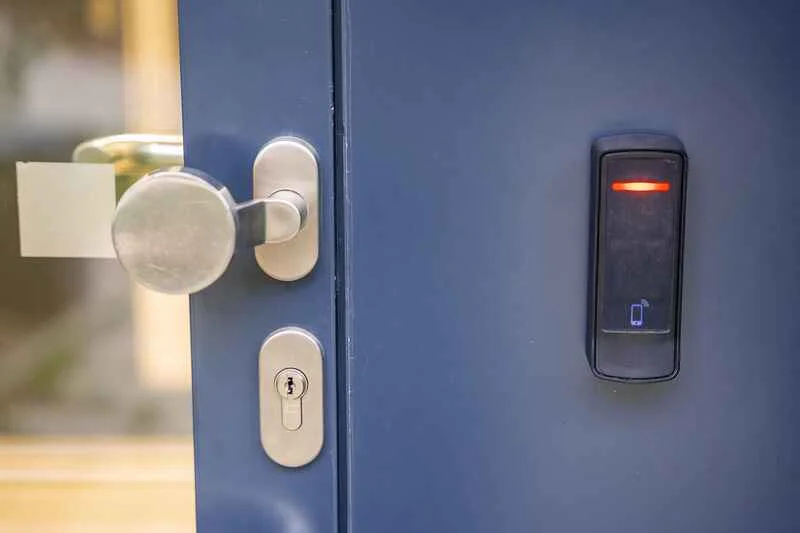
Standard locks are built to keep honest people out, but a determined intruder with simple tools can defeat many of them quietly. High-security locks are engineered specifically to resist the quiet, tool-based attacks — picking, drilling, bumping, and unauthorized key copying — that ordinary hardware does not. For Norfolk County and Greater Boston property owners, here is how high-security locks work and where they are worth the investment.
A high-security lock combines physical attack resistance with key control, addressing two of the main ways a lock is defeated.
What makes a lock high-security
High-security locks use hardened components, pick-resistant pin designs, drill-resistant inserts, and tighter tolerances than standard hardware. They are tested and rated against forced and surreptitious entry. The Builders Hardware Manufacturers Association certifies locks against picking, drilling, and physical attack, so a genuine rating tells you what a lock actually withstands rather than relying on marketing claims.
Resistance to picking and bumping
Lock picking and bumping manipulate the pins of an ordinary lock to open it without the key, quietly and without damage. High-security cylinders use specialized pins and secondary locking elements that defeat these techniques. For a door protecting a home or a business, that resistance closes a vulnerability most owners never think about until it is exploited, which is why pick and bump resistance is a core reason to upgrade.
Drill and force resistance
Beyond manipulation, high-security locks resist brute-force attacks. Hardened steel inserts stop drilling, and reinforced construction resists prying and wrenching. Paired with a reinforced strike plate and a solid door, a high-security lock makes a door genuinely hard to breach by force. We address the whole opening as a system, because the strongest cylinder does little on a flimsy door or a weak frame.
Key control that stops copying
A defining feature of high-security locks is restricted key control: the keys use patented designs that ordinary machines cannot duplicate, so copies are made only with your authorization. This matters wherever contractors, employees, or former tenants have had access. The CISA security guidance emphasizes controlling who can access a property, and key control closes the silent gap that uncontrolled duplication leaves open.
Where homes need them
You do not need high-security locks on every interior door, but certain ones justify the investment: the front and back entrances, a home office, and any door protecting valuables. These are the doors where a quiet, no-damage entry would be most costly. We help Boston-area homeowners target the handful of doors where high-security hardware delivers real protection rather than over-investing everywhere.
Where businesses need them
For businesses, high-security locks protect inventory, records, and cash, and the key control is especially valuable given staff turnover. A restricted system lets a business know exactly how many keys exist and prove copies require authorization. We design high-security and master-key systems for Norfolk County businesses that want certainty over who can enter and the assurance that a departed employee cannot return with a copied key.
Pairing with access control
High-security mechanical locks pair naturally with electronic access control for sensitive doors, combining physical attack resistance with logged, revocable digital access. For many commercial settings, that layered approach is the strongest option. We help businesses decide which doors warrant mechanical high-security hardware, which warrant access control, and which deserve both.
Choosing the right system
Several reputable high-security systems exist, differing in their key control and resistance levels, and the right choice depends on your needs and how the system will grow. Professional installation ensures the lock fits and operates correctly and that a restricted key system is set up with proper records. We help Boston-area property owners choose and install the right high-security locks, targeting the upgrade where it delivers genuine, lasting protection.
Security worth the investment
High-security locks cost more than standard hardware, but on the doors that matter they deliver protection ordinary locks cannot — resisting the quiet techniques, the brute force, and the unauthorized copying that defeat ordinary locks. We help Norfolk County homes and businesses put high-security hardware where it counts, so the most important doors are genuinely hard to defeat.
Owners who take security seriously apply that diligence across their property, keeping trusted help on hand. They rely on providers of trusted residential plumbing help and sewer and drain specialists in their regions when expertise matters.
Your Norfolk County High-Security Lock Specialists
At Ozzy’s Locksmith, we install high-security locks across Norfolk County and Greater Boston — including Quincy, Brookline, Weymouth, Braintree, Randolph, and surrounding Massachusetts communities. Contact us to defeat the quiet attacks, and see our high-security lock services for the right protection.